No labels, no tracking: how to build your own proof of postage
store.fan generates no carrier tracking, so the evidence trail is yours to keep. One habit at the post office counter stands between you and a lost dispute.
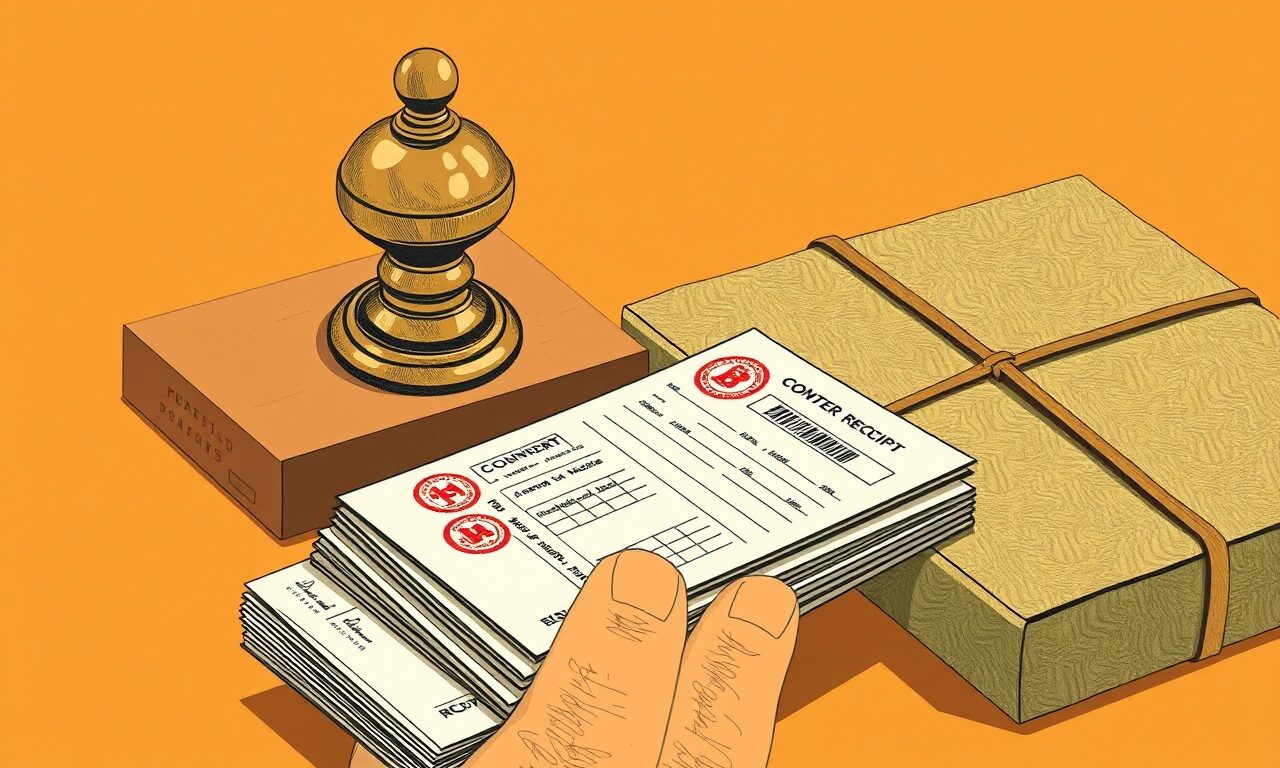
The clerk slides the parcel onto the belt and asks whether you want a receipt. You are in a hurry, the queue behind you is six deep, and you say no. Eleven days later a buyer tells you their order never turned up, and everything you know about that parcel lives in your memory: a Tuesday, probably, the smaller box, definitely posted. None of that is evidence. The receipt you waved away was, and in most post offices it costs nothing.
Why the evidence gap opens in the first place
On a store.fan physical order, the platform's job finishes when the payment clears and the address is recorded. There is no carrier integration behind it, so nothing generates a label, a tracking number or a delivery scan. That is a clean division of labour right up until somebody says the parcel never came, at which point you discover that the only person holding any proof is you, and only if you thought to collect it.
The genuinely hard part is that the habit has to be formed before you need it. Nobody keeps receipts diligently in month one, because month one has no disputes in it. The receipts you will want are the ones from three months ago, gathered on ordinary days when nothing seemed at stake. There is no way to reconstruct them afterwards.
It is also worth being clear about what a plain proof of postage can and cannot do. It shows a parcel of a given weight and class went into the network on a given date from a given branch. It does not show what was inside it, and it does not show that it arrived. That gap is exactly why some creators pay for a tracked service on higher-value orders and accept the risk on cheap ones.
Memory against a file you can hand over
The difference between creators who handle a lost parcel calmly and those who dread it is not luck, it is filing. One has a folder with a receipt, an order reference and a dated message to the buyer. The other has a feeling about a Tuesday. store.fan gives you half of that automatically, in the order record and the customer list, which exports to CSV on every plan including Free. The other half is a piece of paper you have to ask for.
| Memory and good intentions | A file you can hand over |
|---|---|
| Posted it, fairly sure, probably Tuesday | A stamped counter receipt with a date and a branch |
| Address remembered from a message thread | The address as submitted, on the order record |
| No note of what the buyer was told | A dated dispatch message in your own sent folder |
| Postage cost lost among general spending | Postage paid recorded against the order reference |
| Receipts in a drawer, unsorted | Receipts photographed and filed by month |
| A dispute answered with an apology and a story | A dispute answered with three attachments |
The counter habit, in six steps
This adds perhaps ninety seconds per post office trip. It is the highest-return ninety seconds in a small physical shop.
Every trip to the counter
0/6When to pay for tracking anyway
Set a value threshold and stick to it. Above it, use a tracked or signed-for service and treat the extra cost as insurance you are choosing to buy. Below it, plain proof of postage and a willingness to resend is usually cheaper than the upgrade across every parcel. Whichever you choose, it belongs in the flat delivery fee you set on the product, not in a hopeful mental note. The pricing page is a reminder that the platform is not taking a cut of that fee: it is 0% on every plan.
A worked example, with illustrative figures
Say you post forty parcels a month at an average order value of GBP 28. Upgrading every one to a tracked service might cost an extra GBP 1.20 each, or GBP 48 a month, which is roughly the value of one and a half orders. If you lose one parcel a quarter, tracking is expensive protection. If you sell items at GBP 90 and lose one a quarter, the arithmetic flips completely.
The middle path most small shops end up on is a threshold: plain postage with a stamped receipt below a certain order value, tracked above it, and the delivery fee set so both are covered on average. Your per-product figures in analytics tell you what the real mix of order values looks like, which is usually different from the mix you imagine. The numbers here are illustrative and yours will differ.
Get your orders and addresses in one place so your receipts have something to be filed against.
Create your storeThe mistake most people make
The mistake is collecting evidence only for the orders that feel risky. Risk is not visible in advance: the buyer who disputes is almost never the one you had a feeling about. A habit applied to every parcel costs ninety seconds a trip, while a habit applied selectively costs the same effort and protects a fraction of your orders. The other mistake is keeping receipts and never matching them to an order, which leaves you holding forty slips and no way to prove which one belongs to the buyer who is complaining. Match on the day, or do not bother collecting them.
No. It never buys postage or prints a carrier label, so there is nothing for it to track. Any tracking comes from a service you paid for at the counter.
It helps. It shows a parcel of the right weight and class went into the network on a date consistent with the order, which is more than most sellers can produce. It is not conclusive on its own.
From the order in Dashboard, Orders, and from your customer list, which exports as CSV on every plan. Save a copy alongside the receipt rather than relying on the dashboard later.
Longer than you think you need to. Disputes can arrive months after a sale, so a year is a sensible floor and it costs nothing but an envelope.
You cannot control what happens to a parcel once it leaves your hands. You can control whether there is a piece of paper proving it left them. That is the whole of it, and it takes a minute and a half a week.
Start free, take your first physical order, and begin the receipt habit with parcel number one.
Start for freeTurn your knowledge into income
Launch your Store.Fan in minutes — sell digital products, courses, and calls straight from your bio. Free to start.