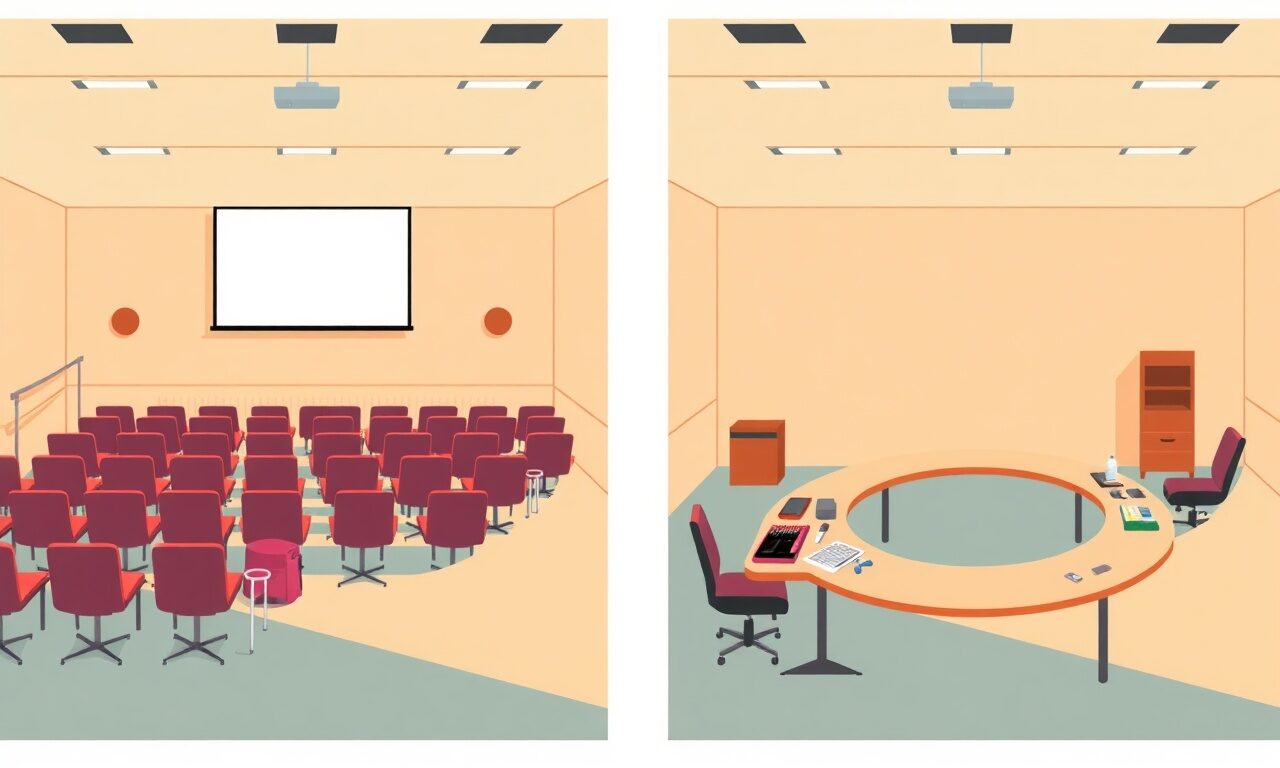
Community or membership: which of the two should you sell first?
One asks you to publish every week, the other asks your members to talk. A straight comparison of the work, the churn and the pricing.

You have decided to sell something recurring. You have even settled on a price. Then you get to the point of choosing what the thing actually is, and the two options sound like synonyms: a membership, or a community. People use the words interchangeably in conversation, which is fine, right up until you have to commit to one and discover that they demand completely different work from you for the next two years.
The difference that actually matters
A membership is a subscription to your output. Members pay because you make things they want: lessons, files, recordings, a monthly drop of something useful. If you stop producing, the value stops immediately and obviously. The relationship runs from you to each member, one at a time, and it scales well, because the hundredth member costs you no more effort than the tenth.
A community is a subscription to other people. Members pay because of who else is in the room and what happens when they post in it. Your job is to host: prompt, reply, introduce, keep the tone. It does not scale the same way, because attention is the product and yours is finite, but it survives a quiet week from you far better than a membership does.
Here is the honest bit that decides it for most people. A membership fails when you burn out, and burnout is largely under your control. A community fails when the room stays silent, and silence is only partly under your control. If you are the sort of person who reliably ships work but finds constant conversation draining, sell a membership. If you are energised by replying to people and dread a content calendar, sell a community. Both are legitimate. Choosing the one that suits somebody else's temperament is what makes month five miserable.
Bolting recurring billing onto what you already have
Most people's first recurring product is assembled from parts: a chat group somewhere, a payment link, a spreadsheet of who has paid. It works at ten members and creaks at forty. Here is what changes when the recurring thing is a product type rather than an arrangement.
| The assembled version | A store.fan membership or community |
|---|---|
| Payments taken separately, access granted by hand | Access follows the payment, and ends when the payment ends |
| A spreadsheet of who has paid, updated when you remember | One customer list built automatically, with lifetime value per person |
| Cancellations arrive as awkward messages | Members cancel themselves, without a conversation neither of you wanted |
| Only monthly, because annual was too fiddly to manage | Monthly or yearly billing, with automatic renewals either way |
| No idea which product is carrying the income | Views, buyers and revenue per product, plus traffic source |
| A platform cut on top of card fees | 0% platform fee on every plan, with Stripe's own card fees still applying |
The two, side by side
Read this table as a description of your next twelve months rather than a feature list, because that is what you are choosing between.
| Membership | Community |
|---|---|
| You promise output on a schedule | You promise a room worth returning to |
| Effort is production: making the thing | Effort is hosting: prompting and replying |
| Scales cleanly as numbers grow | Gets harder to host as numbers grow, easier to sustain as it does |
| Members lapse when the output slips or piles up unread | Members lapse when the feed goes quiet |
| Works with a small audience if the output is specific | Needs a critical mass of people willing to talk |
| A quiet week from members is fine | A quiet week from you is survivable |
How to decide in an afternoon
Do not decide by which sounds more appealing. Decide by evidence you already have, in this order.
- 1Look at your last three months of output. If you shipped something useful most weeks without being asked, a membership has a foundation. If you did not, believing you will start now is optimistic.
- 2Look at your replies. Count how many conversations you have had with your audience in the past month. If the answer is close to zero, a community will feel like a room you have to fill from nothing.
- 3Ask what people actually come to you for. Advice and answers point to a community. Materials, templates, lessons and recordings point to a membership.
- 4Write the renewal sentence for each: 'You are paying me again this month because...' Whichever you can finish honestly is the product.
- 5Sanity-check the numbers. Multiply the price by the number of people you genuinely believe would pay today, not the size of your following.
- 6Create it as its own product type on store.fan, with monthly and yearly options, so people who want to commit can.
- 7Write the description around the promise you just wrote in step four, and be specific about what does not come with it.
The same price, two different years
Take 12 a month and thirty members. Both products produce the same number on your dashboard and completely different calendars. The membership version means roughly four pieces of real work a month, every month, whether or not you feel like it, and each one has to be good enough that nobody looks at their bank statement and wonders. The community version means perhaps twenty minutes a day of prompts and replies, no deliverable, but no way to get ahead of it either.
There is no correct answer, only a fit. What is worth noticing is the yearly option, available on both: a member who pays yearly has bought themselves a quiet fortnight in which they do not reconsider. That is not a trick, it is why yearly billing exists, and it is usually the difference between a product that survives its first slow month and one that does not.
Set up one recurring product properly, with billing, access and cancellation already handled for you.
Start free todayThe mistake most people make
They sell both, immediately, as tiers: content at one price, content plus the room at a higher one. It looks like more value and it is twice the work in the month when you have the least evidence about which half people want. Sell one. Do it for a quarter. Then, if the membership's members keep replying to each other in the comments, add a community; and if the community keeps asking where to find your old material, add a membership. The second product will be far better designed for having waited, and your analytics will have told you which one to build rather than your hopes.
Yes, they are separate product types and both can sit on your page at once. The question is not whether the software allows it but whether you have the hours for both promises. Most people should start with one and add the second when the first is genuinely steady.
It depends entirely on which one you are suited to running. A membership churns when the output slips or when members stop consuming what they already have. A community churns when the room is quiet. Neither is inherently stickier than the other in the hands of the wrong host.
Price the one you are selling on what it replaces for the member, not on what it costs you. Both support monthly and yearly billing, and offering both cycles usually raises the average commitment without you doing anything clever.
Access follows the payment, so it ends when the billing does, and members can cancel themselves without messaging you. That self-serve exit is worth having: it removes the small anxiety that stops cautious people joining in the first place.
The two words get used as if they mean the same thing because, from the outside, they look the same: a monthly payment, an inside and an outside. From your side of it they are opposite jobs. Pick the one whose bad weeks you can live with, write the renewal sentence, and put the other one down for at least a quarter. Both product types, and the eight others that can sit on the same page, are described on the memberships page and across features.
Choose one, build it this week, and let the billing and access look after themselves.
Create your productTurn your knowledge into income
Launch your Store.Fan in minutes — sell digital products, courses, and calls straight from your bio. Free to start.